
Every month, businesses, homeowners, schools, hotels, and commercial buildings receive the same reminder: energy is not free.
Electricity bills rise. Fuel prices shift. Grid demand increases. Infrastructure ages. And for many organisations, energy has become one of the most unpredictable operating costs.
But above every building, every day, there is a power source that does not send a bill.
The sun never sends an invoice.
That simple truth is changing the way we think about buildings, design, and long-term energy independence.
A New Way to Think About Buildings
For decades, buildings have been designed first, and energy has been added later.
A roof was built, then solar panels were placed on top. A façade was completed, then energy efficiency upgrades were considered. A structure was finished, then the question became: how do we power it?
Today, that thinking is evolving.
Modern architecture is moving toward buildings that do more than provide shelter. They can generate power, reduce operating costs, support sustainability goals, and create long-term resilience.
This is where self-powered buildings and Building-Integrated Photovoltaics, also known as BIPV, become so important.
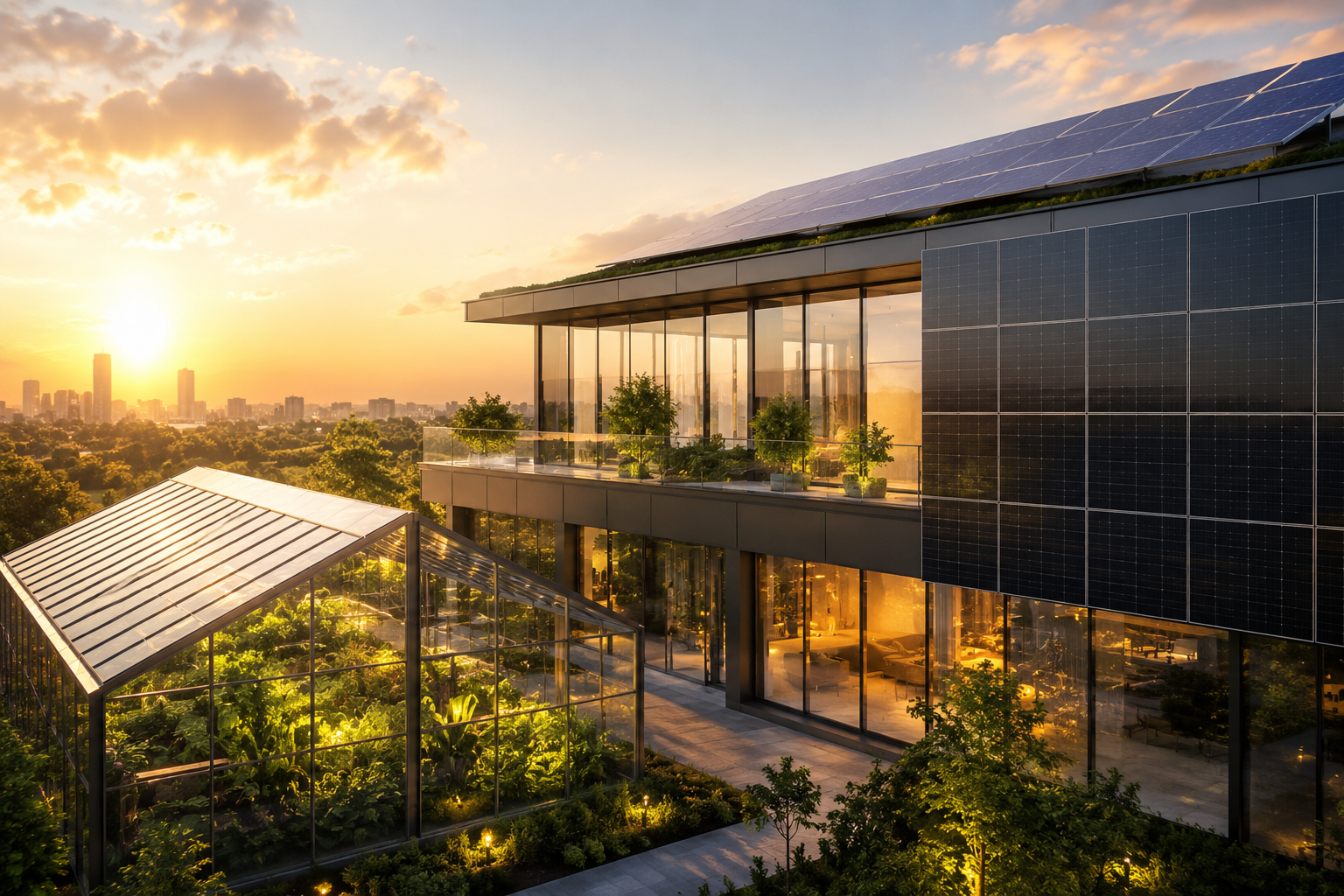
Instead of treating solar technology as an afterthought, BIPV allows solar energy systems to become part of the building itself. Glass, façades, rooftops, canopies, greenhouses, and structural elements can all play a role in generating clean energy.
The result is not just a building with solar panels.
It is a building designed to work with the sun.
Energy Costs Are No Longer Just a Utility Issue
Energy is now a business issue, a design issue, and a sustainability issue.
For commercial buildings, schools, hotels, and industrial sites, rising energy costs can affect budgets, pricing, operations, and future planning. For homeowners, high electricity bills can place pressure on household finances. For developers and architects, energy performance is becoming a key part of long-term building value.
A self-powered building helps shift that relationship.
Instead of relying completely on external energy providers, a building can produce part of its own power directly from the sun. This reduces dependence on the grid, lowers exposure to energy price increases, and supports cleaner operations.
The sun is not affected by market volatility.
It does not increase its rate during peak season.
It does not charge more because demand is high.
It simply rises.
The Beauty of Design-Led Solar
One of the biggest misconceptions about solar energy is that it must look purely technical or industrial.
That is no longer true.
Today, solar architecture can be elegant, modern, and visually impressive. Glasshouses, solar façades, canopies, and integrated rooftop systems can be designed to complement the building rather than disrupt it.
This is where design-led energy becomes powerful.
A solar building should not only perform well. It should also look beautiful, feel intentional, and add value to its environment.
For residential spaces, this could mean a modern glasshouse that supports plant growth while generating clean energy.
For commercial spaces, it could mean a striking solar façade that reduces energy costs while strengthening the brand’s sustainability image.
For hospitality spaces, it could mean luxury buildings that remain beautiful while reducing their environmental impact.
Solar design is no longer just about power.
It is about possibility.
Why Self-Powered Buildings Matter
Self-powered buildings are not only about reducing bills. They are about creating smarter, more resilient spaces for the future.
They can help:
Reduce long-term electricity costs
Lower carbon emissions
Improve energy independence
Increase property value
Support sustainability targets
Protect against rising utility prices
Create more efficient commercial and residential environments
For schools, this can mean lower operating costs and stronger sustainability education.
For businesses, it can mean improved financial planning and a more responsible brand position.
For hotels and resorts, it can mean maintaining luxury while reducing environmental impact.
For communities, it can mean a cleaner, more resilient energy future.
The Future Will Belong to Buildings That Produce
The buildings of the future will not only consume energy.
They will produce it.
They will be designed to capture sunlight, manage energy more intelligently, and reduce unnecessary waste. They will combine architecture, engineering, sustainability, and long-term economic thinking.
This is not just about adding technology to buildings.
It is about reimagining what buildings are capable of becoming.
A roof can become a power source.
A glasshouse can become an energy generator.
A façade can become a solar surface.
A building can become part of the solution.
The Sun Is Already Working
Every day, sunlight lands on rooftops, glass, land, car parks, greenhouses, commercial buildings, homes, schools, and hotels.
Much of that energy is unused.
The opportunity is to capture it intelligently and design buildings that benefit from a resource that is already there.
Because while energy companies send invoices, the sun does not.
It gives light. It gives warmth. It gives power.
The question is whether our buildings are ready to use it.
The future of energy is not only in the grid. It is above us, around us, and ready to be built into the spaces we live and work in.